Showing posts with label Peanut. Show all posts

Thursday, March 27, 2014

Sabudaana Khichdi- Sauteed Sago pearls

(Above: Prepared in the Gujrati style)
Serves 3 as a light meal. Preparation time: 10 minutes.

Ingredients:

2 rice cooker cups Sabudaana, called Saggubiyyam in Telugu (Sago pearls)
Salt to taste
2 tbsp ghee
1 tbsp green chillies chopped fine

Additional ingredients: 

Marathi style:
2 rice cooker cups roasted peanut powder (roast peanuts & then powder them)
Red chilli powder to taste 

Gujrati style:
1 small onion chopped fine
1 tsp Jheera seeds

Method

Soak Sabudaana pearls overnight, the pearl should collapse into a soft crumbly paste when pressed. Soaking time depends on the quality/size of the pearls: 6 hours, or even 3 hours is okay for some beads.
Dry roast the peanuts (you can add a drop of oil), let cool and powder into coarse granules. 
The sago pearls swell & increase in volume, we need nearly an equal volume of peanut powder.

Marathi style
Heat ghee in a cauldron. Add green chillies. 

As they fry, drain the Sabudaana pearls in a colander. 
Mix in the peanut powder and red chilli powder, the peanut powder coats the Sabudaana pearls. Also add salt.

When the green chillies brown, add in the peanut coated Sabudaana pearls. Stir well & cover. Cook until the Sabudaana pearls turn translucent. Cook longer if you want the pearls fried. (5 to 10 minutes)

Gujrati style

Heat ghee/oil in a cauldron. Add jheera, when it splutters, add the green chillies, onion & salt. 
When they brown, add the drained Sabudaana pearls. Stir, cover & cook until the pearls turn translucent. 

Trivia:
I learnt the Marathi recipe from my mother-in-law, having spent years in northern Andhra Pradesh (should I call it northern Telangana now?) on the border with Maharashtra, my mother-in-law is familiar with Marathi cuisine and has incorporated several of their dishes into her cooking over the years. She cooked it when she was visiting Summu in Jersey City, Summu's papa had a great time eating his mother's yumyum food while I assisted & clicked pics! 

I have seen the Gujrati style made by some Gujrati aunties I know, they used oil instead of Ghee though.
Both styles have their own unique flavours, I make according to my mood. 
Sabudaana is just starch, the addition of peanut powder makes it a better balanced meal by adding protein. I also like adding more vegetables (green peas, potato, bell peppers). Do try to cook this in Ghee, Ghee lends an amazing flavour to this dish and I am a ghee addict :-)
I never knew Sabudaana could turn out so delicious, I absolutely loathed it as a child, as I only knew watery gummy Sabudaana gruel, a yucky preparation eaten with yogurt when one got the runs LOL!!
Then I discovered this yumyum Khichdi, which reminds one of the flavour of saggubiyyam vadiyalu!
This is a quick, delicious snack which can be had for breakfast or a light dinner. 

Monday, October 4, 2010

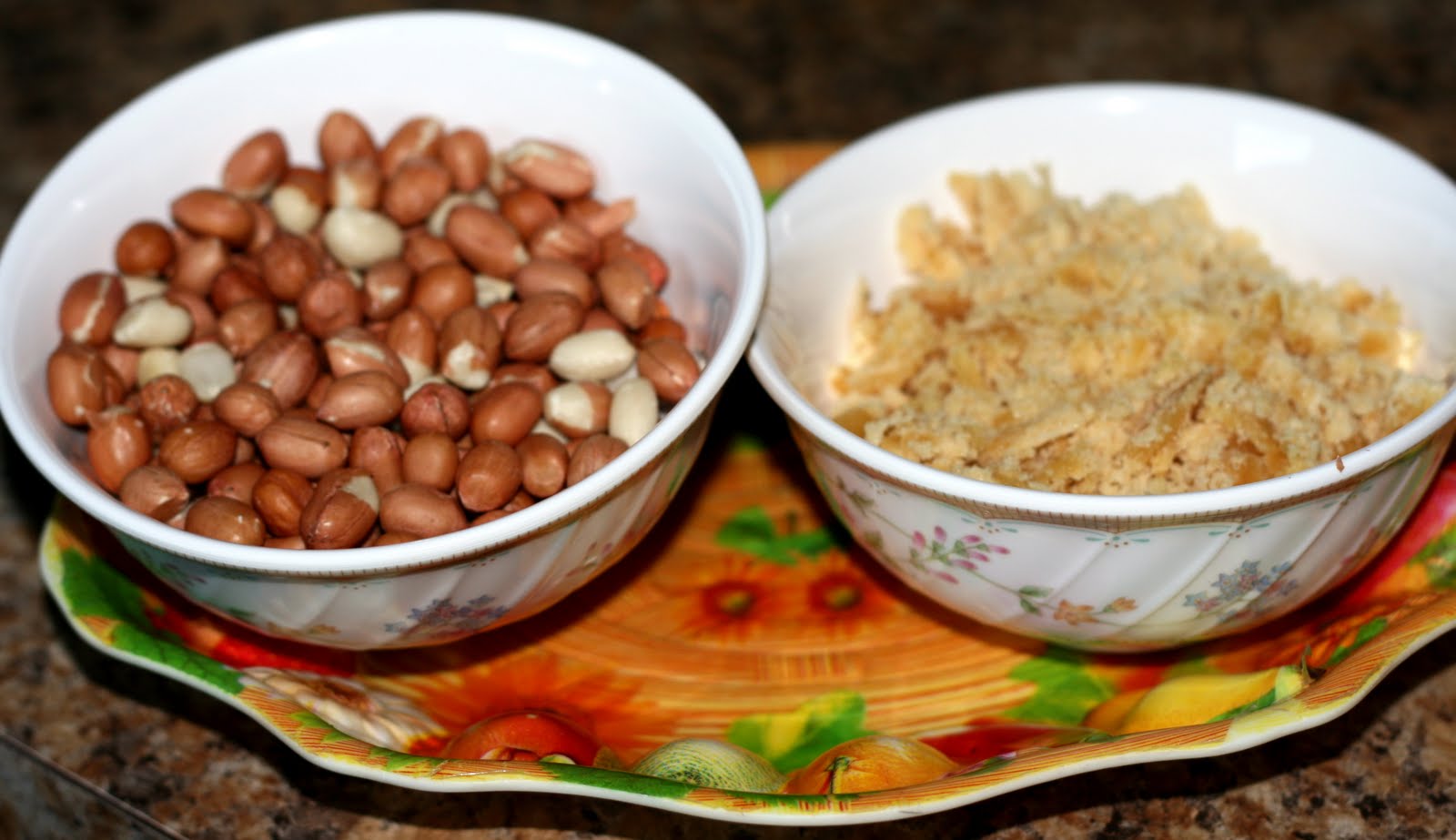
వేరుసెనగ ఉండలు: Verusenaga Vundalu- Peanut & Jaggery Sweet


INGREDIENTS:

1 Cup Peanuts/verusenagapappu
1 Cup Jaggery (grated)
Water to melt the Jaggery.


METHOD:


1. Dry roast peanuts and let it cool.
2. Now remove skin by rubbing the peanuts with your palm.
3. Separate skin from nuts and keep aside.
4. Heat jaggery in a pan, adding little water.
5. When the syrup becomes a thick string, add peanuts and mix well.
6. Remove from fire and make desired size balls.


Caution : You have to make balls after applying ghee on your hands however your hands will become red because of the hot nuts & jaggery.

Variations : Grease the plate and spread the nuts on it and allow it to cool. Now with a knife, cut it into desired shapes.

Monday, March 29, 2010

Idli Chutney

Serves: Four persons. Preparation time: 20 minutes

Ingredients:
1 cup Peanuts
1/4 cup Split Bengal gram (Chana dal, Senaga pappu)
1/2 tbsp tamarind pulp
1/2 tsp Salt or to taste
2 Dry Red Chillies or to taste

For Tempering:
1 tsp split black gram (Urad dal, Minappappu)
1 tsp Mustard seeds
2 pinches Asafoetida
3 Curry leaves (Kadipatta, Karuvepaku)
1 tsp oil

Method:
1. Break the Dry Red Chillies into pieces and dry roast them until they turn red-brown and give off an aroma, around 2 minutes on a low flame. Set aside. 
2. Dry roast peanuts until they are browned and give off an aroma, around 2 minutes on a low flame. You may use a drop of oil. Set aside. 

3. Dry roast the Senaga pappu until it turns light golden brown and gives off an aroma, around 1 minute on a low flame. Set aside.
4. When the ingredients from steps 1. to 3. cool down, grind them in the mixer with salt and water (around 1 cup) to make a smooth paste. Transfer the chutney into a bowl and mix in the tamarind paste. It may look runny initially, but the peanuts/bengal gram soak & absorb the water thereby improving its consistency.
5. Heat oil in a small saucepan or flame proof ladle. Add Minappappu. When it browns, add Heeng, Mustard seeds and Curry leaves. Turn off the heat. Pour this tempering over the chutney and stir it in. 


Variations:
Use more tamarind paste if you like sour tones. Some recipes include desiccated coconut powder or fresh grated coconut. You may also add green chillies during the grinding process. Yet others include garlic, though it is really not traditional.


Culture & Tradition:
This chutney is traditionally served with Idli or Dosa


Trivia:
This recipe courtesy Manju pinni.

Monday, February 15, 2010

వేరుసెనగ పచ్చడి/Verusenaga Pacchadi / Groundnut Chutney


Preparation Time: 15 mts
Serves: 3-4 persons
Region: Rayalseema, Telangana
Utensils: Wok/Pan, small seasoning Pan, Wooden Laddle, Indian Mixer-Grinder/Coffee Grinder

Ingredients:

1 cup peeled and roasted Peanuts/Verusenagakayalu
1 small Onion peeled and sliced/Ullipaya
1 pod Garlic peeled and crushed/Vellullipaya
6 dry Red Chillis, de-seeded, broken into pieces/Endumerapakayalu
2 tsps Til/Gingelly/Seasame Oil/Noona
1/2 cup Water/Neellu
Juice from small lemon sized Tamarind (soak in warm water for 15 mts)/ 1 tablespoon Tamarind paste/Chintapandu Gujju
Salt to taste/Uppu


For Tiragamutha/Popu/Tadka/Seasoning:


1/2 tsp Mustard Seeds/Avalu
Pinch of Asafoetida/Hing/Inguva
8-10 Curry Leaves/Karivaypaku
1/2 tsp Oil/Noona

Method:

1. Heat oil in a Pan or Wok,
2. Add the Garlic and dry Red Chillis and stir fry for a few seconds till they are browned.
3. Add the sliced Onions and saute further for 4-5 mts on medium heat till they are translucent.
4. Turn of heat and cool.

5. Grind coarsely the roasted Peanuts, Tamarind pulp, the Onion/Garlic/Chilli mixture along with Salt and half a cup of Water.

Separately
6. Heat Oil in a pan for seasoning.
7. Once hot, add the Mustard Seeds and once they splutter,
8. Add Asafoetida, once you get the aroma
9. Add the Curry Leaves and turn off heat
10. Pour the Oil mixture over Chutney.

Accompaniments:

1.Works excellently with Idlis or Dosas.
2.Can be eaten mixed with Rice and Ghee,
3.Spread over Bagel or Bread like Peanut Butter,
4.Dip for fresh Vegetables or Crackers,
5.Side Dish for Chappati, Roti, Paratha

Modifications:

You can skip the Onion and Garlic if you are Jain or Vaidika/Sattvika!
Instead add freshly grated Kobbari/Coconut to the peanut puree and give a quick run in the mixer
Garnish with freshly cut Kothimeera/Dhaniyapatta/Cilantro instead of Curry Leaves


History:


Peanuts originated in South America, probably in Brazil and Peru. They were grown as far north as Mexico by the time the Spanish began their exploration of the New World. When the explorers returned to Spain, they brought peanuts with them. Later, traders were responsible for spreading peanuts to Africa and Asia.

Home Remedy:

Peanuts are not recommended in Ayurveda. Peanuts are not really nuts; they are legumes. Peanuts are difficult to digest and can make one feel sluggish and lethargic in body and mind. Ayurvedically, it is better to use either cashew or almond butter for sandwiches.


Backstory:


I love this Pacchadi a lot! Its easy to make and is very healthy too. Had a lot of it in Bidar, Karnataka.If you are close to Karnataka or Maharashtra you cannot avoid this chutney as that region is the largest peanut growing region of India. 'Shenga Chutney' is ubiquitous in any Marathi or Kannada home of Bidar/Gulbarga and Marathwada which were under the Nizam but also those parts of Telangana which were under the Nizam got influenced by this cuisine and adapted it.